10.27.2009

How Pixar and Toy Story Got it All Wrong


OK, I have to say this: the basic premise of Toy Story is creepy and so fundamentally wrong. (Yes, I've seen the film with my boy — twice. This is but just one of the many humiliations sustained in my role as dad.)

Sid — the supposed evil kid next door — may be kind of a dick but he's unbelievably creative. When he looks at a toy, he sees opportunity. He sees possibilities. A toy, to Sid, is a starting point to be shed quickly so he can get on with the act of creating. His toys are a database of gestures and tropes, figures and materials, to be manipulated this way and that.

Sid, my friends, is an artist.

And yet he is so cruelly vilified in the film. And what is Sid's crime? He plays with his toys passionately, creatively, interestingly. Andy, the pansy next door, does nothing but recapitulate Hollywood cliche when he plays — the cowboy, the superhero, love stories. Sid is popping off heads, sewing parts together, welding, melding, molding. Sid is a punk rock artiste.

What lesson is Pixar — which is really Disney — teaching our kids? That one should respect the integrity of commodities? That to toy — ahem — with the corporate prescribed rules is evil? That kids who dress in black and make art are the enemy? That the best way to play is to play it safe, within the stipulated norms set by Hollywood and Mattel?

I tell my son over and over: Sid is maligned. Sid is the real hero here. And I think I'm getting through. Yesterday, he asked me for a rocket so we could blow up some of his toys.

Oh yeah.


10.09.2009

On Soft Architecture, via Lisa Robertson

We live in spaces and amongst things that are infused — with memory, mood, texture, tone, timbre, resonance. Buildings, roads, bridges: they are not hard and rigid but structured events, experiences lived all the way through, soft. This is soft architecture.

Design offers more than a spine; it offers — no, it is — an algorithm of possible experiences, combinations, folds, and juxtapositions.

Soft architecture is a phrase from writer, Lisa Robertson, with which I am thoroughly enamored. In fact, I'll say it again: soft architecture. I'm smitten with this phrase. Which is, precisely, the nature of the architecture of soft architecture — ideas are mooded invisible spaces.

Soft architecture turns the world inside out. Or, rather, it facilitates a space that dissolves, renders porous, that line that separates private from public, subject from object. As I enjoy a space, make my way through it, it enjoys me, makes its way through me. Together, we move and are moved. A building, a road, a sidewalk draw me to them and I draw them to me. Together, we make this world. Or: together, we are this world.

We don't unite, world and me; we marble. We are marbled.


Read some Lisa Robertson here

And buy her astounding book here

9.19.2009

The Face: On Richard Avedon


I just saw the Richard Avedon show at SF MoMA. I was cautious, afraid I'd see celebrities. But what I saw were faces — human faces that can't help but bear themselves, that can't help but bear their history and their now.

Avedon's subject is not celebrity at all. In fact, it doesn't matter who's who. What matters is the image — which is to say, the face. This is Avedon's subject, over and over and over: the phenomenology of the face, the way affect lines the flesh and flesh is always and already affected, affective.

The face is the recording screen, the site of consumption and production, where the world enters and where the body plays it back according to its necessarily particular metabolism.

To see face after face, face upon face, faces with faces with faces, is to witness Leibniz's great monadology: each monad is the entire universe but from its perspective. Walking through the museum show, I saw the entire universe, inflected just so, in frame after frame.

The face is mesmerizing. There is something so humbling and inspiring about seeing the human face, again and again, knowing that it is making its portrait of you as you look: each image creates your image, your face.

9.01.2009

Giving Way to Itself: Confrontations with Becoming — On the Images of Keira Kotler


We see colors, soft, even luxurious. They seem to invite, to beckon. But linger with them. These are not peaceful. They are not meditative. They do not confirm their space, blending seamlessly with the decor. They do not confirm the viewer, reassuring her that her life is fine the way it is. Nor do they offer an escape, a respite from the fray, as if they were a portal to serenity.

On the contrary, these images are remnants of the fray itself, moments of the great undulating that is life, that is the always urging always surging of this world. These images are moments of the teeming — physical, affective, sensual, emotive — that swarms and swirls about us which we tend to miss, ignore, tune out. But here they are now, impossible to ignore, confronting this space, confronting the viewer — tumult, even if rarely tumultuous, in our midst. It’s as if the volume of life has suddenly been turned up.

The experience is a tad unsettling, uncanny: we know what this is and we don’t know what this is. We reach out, try to grab on to something but there are no lines, no forms, no concepts — nothing to hang on to, just intensities, mooded undulations. They provide neither entry nor escape; the images neither recede nor protrude: they confront. They insist on themselves, on their place right there, right now, confrontations with becoming.

It’s as if Kotler has summoned all her strength to hedge, contain, and amplify the very flutter and throb of the cosmos and present it to us. These are not images of the world; they are amplified fragments of becoming, the patina of life. Somehow, she has managed to transport to us these micro details of experience writ large. What generosity!

How does she do it? Photographs, paintings, videos: these are the technologies Kotler engages to stipulate, embrace, and transport the cosmic surging. She is not the classical artist who lends form to the formless, Yahweh with his clay. She is not the Romantic, spilling her inner self across the canvas in some act of passionate expression. Her hand is nowhere to be seen. No, she is a modern artist who stands amidst the cosmic winds and hedges here and there, steering these powerful forces into a specific site — this frame. Look at the images: this containment doesn’t come easily as they bleed over the edges, looking to extend themselves, unleash themselves.

The cut paintings seem, perhaps, to deviate. But look again. Are these cuts a portal, a way through, a revelation of something else? No. There is nowhere to go, nothing else to see. Where is the cut, anyway? It’s not at the surface, revealing the depths. It’s immanent to it, a portal to, and of, itself. It’s as if this clearly artificial cut with its impossible geometry has reached through in order to teach us what we need to know, what we need to see: this world only gives way to itself.


Visit: http://keirakotler.com

8.30.2009

Rethinking Environmentalism

Here's what I've been thinking:

To suggest that we are somehow harming the Earth, that we have a responsibility to the planet as we are its stewards, is really the same thing as saying: We are privileged on this planet, distinct from it, and hence are free to exhaust and consume all of its many splendored bounty. These are two sides of the same coin.

Read more at Thought Catalog >

8.28.2009

Thoughts on _Inglorious Basterds_

_Inglorious Bastereds_ is a fuck you to the totalitarian cinema of any sort. This film does not flow and build. It builds, jumps, forgets, remembers, jumps, rams. And yet it cops the thrilling tension of narrative. Scene after scene is ripe and peculiarly taut. Resolve is often surprising and grotesque in a Coen brothers sort of way.

Read More at Thought Catalog >

8.27.2009

"The Wire" (again) and the Menace of Quantity

I finally finished all 5 seasons of "The Wire." And, by the end, a clear argument emerges: quantitative thinking quashes humanity.

The cops juke the numbers — play with the stats so it looks like crime is going down — at the cost of actual police work that focuses on the source of the crime. With juking as the norm, cops are trained to think in terms of numbers — quotas, closing the case at whatever cost — rather than knowing how to do real po-lice work — read the evidence, follow the money, put things together.

Real police work is an art — an art of thinking that demands a certain diligence and intelligence. Juking the numbers is for the masses, the zombies: anyone can do it. It is brutish and it ensures that crime in poor old Baltimore actually gets worse.

And the cops that try to do real po-lice work? They're all forced out in the end.

The schools do the same — juke the numbers — as everything from funding, curriculum, and policy turns on test numbers. Poor Mr. Prezbo actually wants to teach his students math, about how numbers work: he wants to teach the quality of numbers. But he has to review test questions so they kids will score better so the bureaucrats will see higher numbers so the politicians win, or lose, which drives everything. It is more than enough to make you weep.

The newspapers do the same as everything turns on circulation and advertising. Real reporting goes by the wayside in favor of false sensationalism. Just to stick it to us, in the end, we get a 2 second flash of Templeton winning a Pulitzer. "The Wire" is relentless.

A system premised on quantity exhausts humanity, drains it of dignity, civility, and grace. Such, David Simon tells us, is our system (we might call this system capitalism), is ourselves.

The Posture of Things

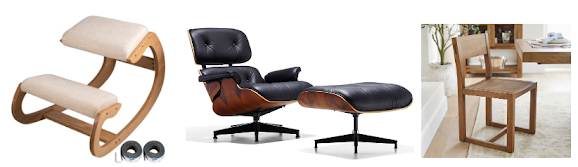
You're shopping for a chair. As you browse the aisles, you note the variety — from backless computer chairs to high bar stools to plush ...