4.22.2009

The mind boggling complexity of paternal play


My son likes to wrestle: "Let's have a battle, Dad," he screams as he runs full speed into my legs, belly, butt, swinging his tight, bony little fists. This happens often. It is a deliriously complex exchange:

1. The play is a competition, the young male trying to outdo the alpha male (it is the only instance when I am, in fact, an alpha male — and even that standing is precarious).

2. The play is an education as the alpha (me!) teaches the young beast how to wrangle, defend, attack. It is presumably in my best interest to make him able to defend himself so he can continue to carry on my genes and so he can hunt for the pack.

3. But simultaneously I am training him to beat me.

4. And yet when he senses that he can beat me, he backs off nervously. He wants his alpha to be strong and capable. And so the play seeks at once to confirm my position as king of the pack and to dethrone me.

5. There is, too, a beautiful madness, a delirium, to these battles as we heave, tickle, swat each other in a frenzy of laughs and snorts, a Dionysian release of a sort.

How am I to play my role? It is an ever shifting negotiation in which I sometimes let him win — whatever "win" means in this context—, sometimes dominating him mercilessly, sometimes showing pain (his bony little body hurts!), sometimes not. I am alternately defending my position, playing pedagogue, and putting the beast in his place.

Just this moment, he left for his capoeira class that I am paying for. I am funding my imminent demise.

4.20.2009

It is what it is, redux

In popular parlance, "it is what it is" tends to put an end to the discussion. It is uttered, everyone nods in their collective wisdom, and moves on because, well, such is life: it is what it is. The utterance is a call to irreducible difference—"it" is not categorical, there is no shared base of knowledge, and so we will not try to speak it.

And this is, probably, often the best response. Life happens. What is there to say about it?

But to assume that something that lacks category — something that is its own category, is sui generis — cannot be spoken is to assume that language speaks in and of categories.

Language, however, gets interesting precisely when we realize that it is not solely categorical, when we realize that language is experiential. Language is as immediate and sensual as it is conceptual and categorical.

And so, for me, I find those moments when it is, indeed, what it is a great provocation to speak, to write, to deploy language. I have neither hope nor desire that my language will name it, categorize it, grasp it. No, I want my language to move with this thing, with this life.

I want the difference of this world, those moments that beguile us, that tantalize and overwhelm and confound, to spawn more and more life. I don't want them to quiet life. I want them to amplify life. And so I speak, and I write, difference.

4.19.2009

It is what it is

Every communication succeeds, necessarily. You say something. I hear it, or don't. Someone else, perhaps, hears it, sort of. In any case, something happened.

Not every communication is understood. You say something. I hear it, or don't. I may understand what you said. My understanding may be all together different from your understanding, or his or her understanding. Understanding can, and often does, go astray.

But understanding is only one component of communication, albeit it important. (Needless to say, our respective understandings of understanding no doubt differ.) Understanding may be one moment within a communicative event that is itself an affective or effective machine — you understand what I say and, upon so doing, begin weeping or kissing or fleeing or punching.

But communication per se can't help but succeed. As they say, in a bit of popular phenomenological wisdom, it is what it is.

The Folds of Language

I have lived with Deleuze's fold for over a dozen years. At times, its power as a figure speaks to me immediately, eloquently.

I was drinking tequila with the good Dr. L Green the other evening as we were discussing how best to perform becoming. To render it visually seemed right and, at the risk of offense, easy. But to express it linguistically posed a completely different challenge: how to perform becoming without naming and yet still being in language which necessarily names.

This may be obvious. We may all know this already: language describes and does, at the same time but not necessarily in the same breath (to say I'm cool does not make me cool — an yet to say I'm cool does do something, is itself part and parcel of becoming). But, as I said, at certain times the power of this idea resonates with me, a harmonic convergence that makes my entire body vibrate.

Which is perhaps the point: the idea is folded through the body.

Folds upon folds.

The descriptive power of language — the meta — folds into its own materiality — its performativity, yes, but also its palpability — to form a sense event that is at once meta and material. And that is precisely what that very idea does to me: I understand it, yes, but I experience it as well, the idea itself a sensual affect that does not efface the ideality of the idea.

If that makes sense.

To speak, to write, is to fold. Such is language. It does not first name and then perform. Nor does it perform and then name. Neither precedes the other; neither effaces the other. The meta and the material are folded in every inscription, in every utterance, in ever different ways, at every different angles.

We might call these folds "tropes."

Deleuze's book >

2.13.2009

Joaquin Phoenix, a genius, jams the circuit


His posture, his play, is brilliant. The Letterman machine with its ready quips and its obedient audience that laughs and claps on command wants Phoenix to play his part. At first, Letterman tries to cajole him into advocating the actor's film—that is, to advertise the film, for that is what the Letterman show is at its most basic: an ad for Hollywood dreck.

Phoenix, however, does not play along. But what's so great, what's so brilliant, is his tactic. Once Letterman can't get him to play the ad man for the film, what options are left? Phoenix must be crazy—loaded or crazy, like Farah Fawcett. These are the options this idiotic machine offers: sell the goods or you're a lunatic.

But Phoenix plays neither. He sits sternly, quietly, and lets the madness around him unfurl. Suddenly, it's not him who looks crazy—it's Letterman! It's the inane audience who laughs at nothing, who laughs on command. Listen to what Phoenix says about the audience, "What do you gas them up with?"

Joaquin Phoenix jams the well worn circuits of celebrity. On the one hand, this is easy to do—the circuits are so well known, so well trodden, that to deviate is easy. On the other hand what makes this performance so great is that he never gets folded back into their discourse, back into the rules of their game. He never turns pugilistic, never antagonizes, never plays against what's happening. And nor does he ever allow for a knowing wink within the game, as if to reassure everyone that the money machine is still rolling along, that the life draining rules of propriety are still in play.

Neither fists nor wink, Phoenix chooses the ancient path of the warrior who sits silent and lets his enemies destroy themselves. It was painful for me to watch Letterman squirm and hawk—Letterman, who had once been the one to jam those idiotic circuits of celebrity, Letterman who never had patience for all the bullshit, now Letterman who is at once puppet and puppet master for the same old crap.

Joaquin Phoenix, stoic genius, sits quietly, insistent in his silence, graceful in his posture, refusing all attempts to co-opt him, all efforts to claim him. What a refreshing sight.

1.30.2009

Of Stench and Living with Memory


Courtesy of the good Dr. Lohren Green, poet-sophist-atmospherist, I have been reading the exquisite, hilarious, and, if you'll excuse the misplaced pun, illuminating, "In Praise of Shadows" by Jun'ichiro Tanizaki. Tanizaki considers the Western taste for the sheen against the Oriental predilection for the worn, or what he calls the "glow of grime"—the way touch wears something and bends its relationship to light and, alas, to time.

For instance, in the West, we use shiny tableware, glimmering forks and knives; not so in the East where the muted tin and wood prevail. Tanizaki spends considerable time discussing bathrooms and the horror of the Western camode with its white tiles that amplify the filth of the space.

Reading this, I found myself continuing his line of thought. The Western obsession with the glean speaks to a perpetual eradication of history, of memory. We shine our antiques and in so doing erase the very thing that gives them their charm: the mark of use, the patina of time. In ceaselessly polishing, we erase our past, not just the doings of our so-called forefathers but the doings of ourselves.

I, for one, enjoy a certain whiff of myself—through eyes and nose. I like leaving residue of my goings on—a beer bottle on the coffee table, a torn scrap of paper used for god knows what, and, yes, a tinge of my own urine permeating the bathroom. Of course, culturally, we consider this "dirty."

But this dirt is more than mere marker of events; it is the event. It is, miraculously, the cohabitation of the present and the past. To live amongst one's stench is to live with and amongst one's past, to be present with one's memory—rather than sloughing it like so much dead skin.

And yet no sooner can I mark my temporality than a sponge descends on the scene, wiping my very remnants from this world and leaving me desperately alienated from myself, a (more or less) pure contemporary forced to face the now without the reeking trail of my own becoming. I must start anew, my memory wrung down the kitchen sink.

And so I relish those moments before antiseptic sweeps in, when the room is dense with the memory of me, when I can seep in my past, breathe my memory, and enjoy a certain peace that comes with the stench of time.

1.20.2009

On this whole inauguration thing

So, may I rant for a moment? Of course you can, jewbag, it's your blog!

Ok, so, I know people are all, like, excited for this inauguration thing. And I'm not one to shit on anyone's holiday—only I am the one, precisely, to shit on everyone's holiday. So here I go.

What the fuck? This Obama cat may be an excellent guy. He and his family unit sure seem super cool, no doubt about it. But, first, the inauguration was filled, inevitably, with sanctamonious bullshit proffered by a series of fucking idiots. Is this history redeemed? I may not know a lot about African-American politics but it seems to me that the election of this guy does not do a whole lot for the black men I see on the streets just trying to get by.

C'mon, folks, this is the president we're talking about. How much power does this guy really have? And even if he did have all the power in the world, are we sure we want it in this guy's hands? What's all this nonsense about jesus I heard here and there on various televisions about town during this inaguruation? What the fuck? What the fucking fuck? Isn't this why the world hates us—because we think we know who God is? Because we push jesus on everyone? Goddamn, I'm jewish—and jesus was a jew—and it made me feel left out.

It's the president, people. It's not your dad or your boss or your hubby or your friend. You still have to wake up to the stench of your life, regardless of who pays rent at the white house.

Listen, I hope this guy miraculously brings the change we all seek. I hope he stops bombing folks I've never met. I hope he puts money into our schools because, fuckin' a, we don't know how to educate our youth and it's quite literally killing us. I hope he puts a damper on corporate greed and actually restricts what hedge funds can do, what financial companies can risk.

I know y'all are desperate for change. But, c'mon, there are forces at work here that are big and determined and this guy, however cool, is only the president and is, in fact, not hell bent on fundamental change. He's a politician and not a terribly radical one at that. Yes, he seems competent and cool but government is government and life exceeds the law.

The change we need is drastic. We need a 32 hour work week, not 40, 50, 60, 80 hours. We need basic support of education and libido and love. Can a president do all that? Fuck, I hope so. Will this cat do it? No, because capitalism is greater than any president. The key to change therefore exists elsewhere. Where? In you—and, no doubt, in me.

My fear is that we're all being fooled—no, placated, cajoled into thinking this changes everything. But it's the president! It's not that important! Nothing is more dangerous than the mass accepting of change that is anything but.

I am with you in hoping that there's hope. But I fear I am utterly alone in my hesitation and suspicion.

The Posture of Things

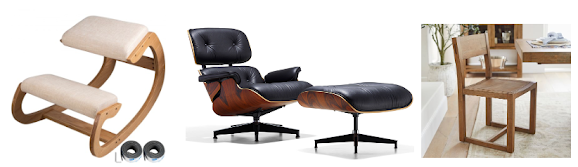
You're shopping for a chair. As you browse the aisles, you note the variety — from backless computer chairs to high bar stools to plush ...